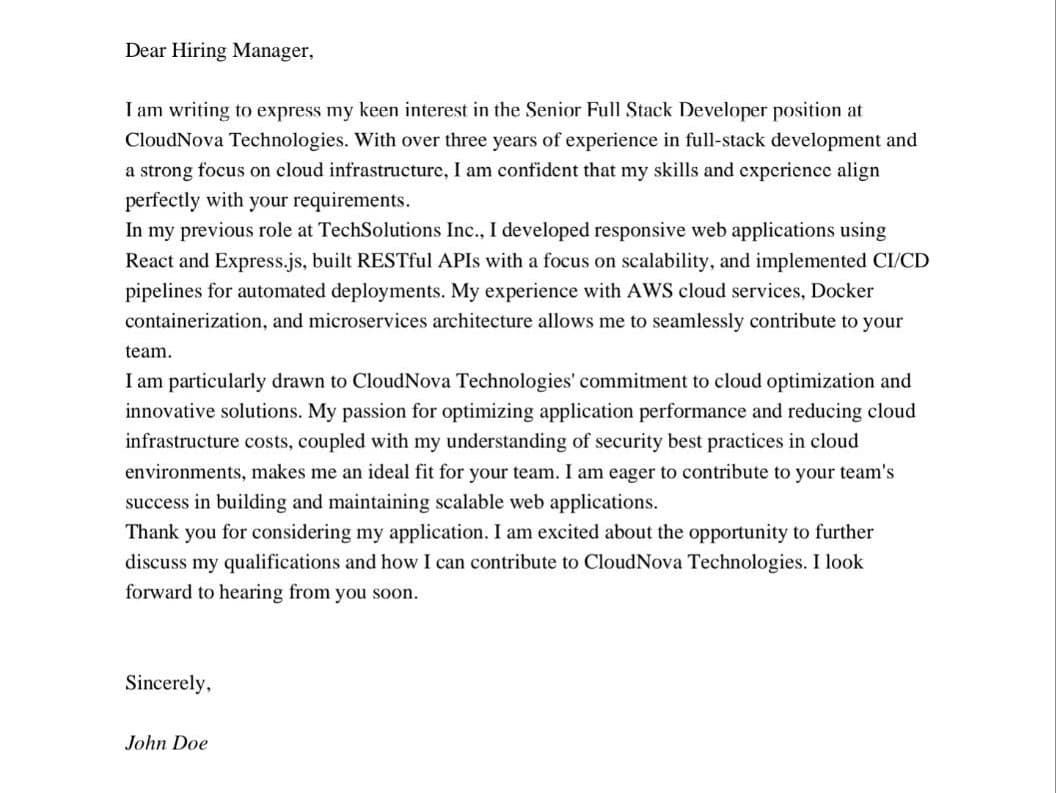
Most job seekers think a cover letter is just a resume introduction. That is why many cover letters get ignored. A truly effective cover letter is your personalized sales pitch that complements your resume, telling a compelling story that addresses specific company needs while showcasing your unique value. The difference determines whether your application gets filed or forwarded to the hiring manager.
Our AI Resume Builder creates perfectly matched resume and cover letter pairs that work together to tell a consistent story. It analyzes job descriptions and your resume to generate complementary documents that increase interview invitations compared to standalone applications.
What Is a Cover Letter? (Complete Definition)
A cover letter is a strategic business document that serves as your personalized introduction to a potential employer. Unlike your resume, which presents facts and achievements, your cover letter provides context, demonstrates fit, and shows how you think and communicate.
The 3 Core Functions of a Modern Cover Letter
- 1. Connection Bridge: Links your resume to the specific job and company
- 2. Value Demonstration: Explains how your experience solves the employer's problems
- 3. Personality Showcase: Reveals your communication style and professional approach
What a Cover Letter Actually Does
- Humanizes Your Application: Adds voice and personality to your qualifications
- Addresses Specific Needs: Directly responds to requirements in the job description
- Tells Your Career Story: Provides narrative context for your resume's bullet points
- Shows Initiative: Demonstrates you researched the company and role
- Creates Memorability: Makes you stand out in a stack of similar resumes
When You Do Not Need a Cover Letter
Despite the enthusiasm for cover letters in this guide, skipping them is often the right move. You do not need a cover letter if the application system has no upload field for one and the instructions say nothing about attaching it. You do not need one if you are applying through high-volume job boards like Indeed or LinkedIn Easy Apply where the cover letter field is rarely read. You do not need one if your network referral is already providing context for your application. And you do not need one if the job posting explicitly says "cover letter optional" and your resume already tells a complete story. In these cases, a rushed, generic cover letter can do more harm than good. Save your best cover letter writing for roles you genuinely want, where you have something specific to say.
Why a "Matched Pair" Beats a Solo Cover Letter
Traditional job applications treat cover letters and resumes as separate documents. Modern hiring practices reward coordinated application packages that tell a unified story.
The Problem with Separate Creation
- Inconsistent Messaging: Different tone, emphasis, or keywords between documents
- Missed Connections: Achievements in the resume not properly explained in the cover letter
- Wasted Time: Writing and formatting two separate documents separately
- Reduced Impact: Hiring managers notice when documents do not work together
The Matched Pair Advantage
Resume Shows: "Increased sales by 45% through new strategy implementation"
Cover Letter Explains: "My 45% sales increase came from identifying untapped market segments exactly the analytical approach needed for your Growth Strategist role."
How AI Creates Perfect Matched Pairs
- Analyzes Job Description: Extracts key requirements and keywords
- Reviews Your Resume: Identifies the most relevant achievements
- Creates Complementary Content: Resume highlights what; cover letter explains why
- Ensures Consistency: Same tone, keywords, and professional formatting
- Optimizes for ATS: Both documents score well in applicant tracking systems
The 4-Part Formula for a Great Cover Letter
Follow this structure for manual creation.
1. Professional Header and Addressing
Manual Approach: Your contact info, date, company address, proper salutation
Common Mistake: Generic "To Whom It May Concern" or incorrect company names
2. Opening Hook: Connect Immediately
Manual Approach: Mention the role, express enthusiasm, reference company research
Common Mistake: Generic openings that could apply to any company
3. Proof Paragraph: Show Your Value
Manual Approach: Select 1-2 key achievements, explain relevance to the role
Common Mistake: Simply repeating resume bullet points without context
4. Confident Close and Call to Action
Manual Approach: Reiterate interest, thank the reader, include a professional sign-off
Common Mistake: Weak closes like "Hope to hear from you"
FAQ: Cover Letter Questions
What is the main purpose of a cover letter?
Answer: To complement your resume by providing context, demonstrating fit, and showing your communication skills. It explains why you are the right candidate for this specific role at this specific company.
How long should a cover letter be?
Answer: 3-4 paragraphs, maximum one page. Hiring managers spend limited time on initial review be concise but substantive.
Should I include a cover letter if it is not required?
Answer: Sometimes. If you have something specific to say about the company or role, yes. If you would be forcing it, skip it.
Can I use the same cover letter for multiple jobs?
Answer: No. Each cover letter should be customized for the specific company and role. Generic letters are easy to spot.
Do hiring managers actually read cover letters?
Answer: Many do, especially at smaller companies and for roles where writing matters. At large companies with high volume, the resume is often prioritized.
What is the biggest cover letter mistake?
Answer: Making it all about what you want rather than what you can offer the company. Focus on employer needs, not your desires.
How do cover letters and resumes differ?
Answer: Resumes show what you have done; cover letters explain why it matters for this specific role. They work together as a pair.
Final Checklist: Effective Cover Letter
- Customized for Role: Specifically addresses this job and company
- Complementary to Resume: Explains achievements rather than repeating them
- Employer-Focused: Addresses company needs, not just your goals
- Professional Format: Proper business letter structure and formatting
- Error-Free: No typos, correct company names and details
- Concise but Substantive: 3-4 paragraphs, maximum one page
- Strong Opening: Immediately grabs attention and shows fit
- Specific Examples: References relevant achievements with context
- Company Research: Shows knowledge of the company and industry
- Clear Call to Action: Expresses interest in an interview or discussion